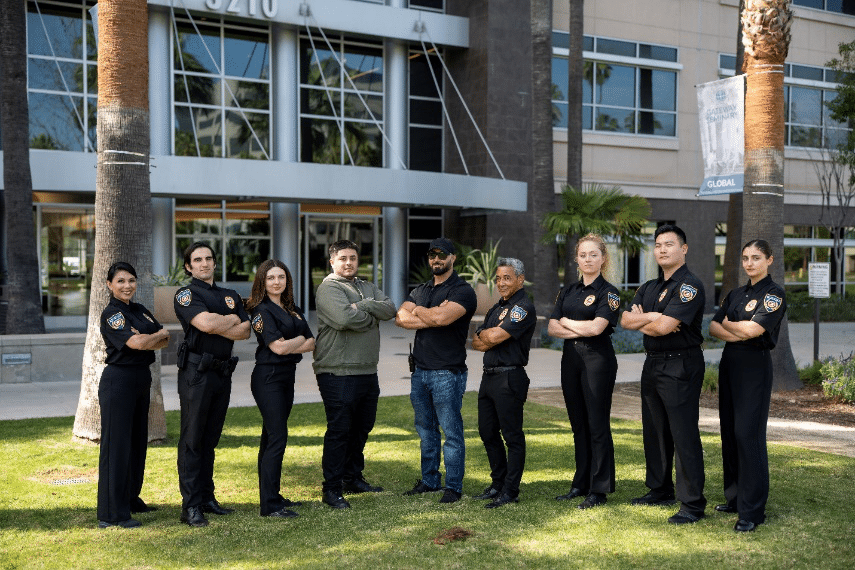

An office building that is fully staffed and monitored for nine or ten hours a day still sits completely unwatched for the other fourteen, plus every weekend. The FBI’s Crime Data Explorer continues to track burglary as one of the most common property crimes nationally, and commercial buildings without an active night presence remain a disproportionate share of those incidents. Scheduled office building security patrols close that window by putting an officer on the property during the exact hours a break-in is most likely to happen. Adding commercial security guards in Riverside to a nightly patrol route is one of the simplest changes that consistently reduces after-hours incidents.
We provide vehicle patrol service built around a building’s actual after-hours risk, not a fixed schedule that happens to look the same on every property.
What Makes an Empty Office Building an Easy Target
Office buildings tend to be quieter and less trafficked after hours than retail or industrial properties, which is exactly what makes them appealing to someone looking to avoid being seen. Electronics, computer equipment, and even petty cash left in a desk drawer are common targets, and a building with no visible activity signals to anyone watching that a break-in is unlikely to be interrupted. Alarm systems help, but by the time one triggers, the point of entry is usually already made.
Weekends and holidays extend that window even further, since a building that sits empty for a full three-day stretch gives an intruder far more time to work without interruption than a single overnight gap during the week. Properties that only staff patrols on weeknights often overlook exactly the stretch of time when they’re most exposed.
What an After-Hours Patrol Actually Covers
A patrol officer assigned to an office building checks every entrance and exterior door on a rotation, confirms alarm panels are armed, and walks parking structures and loading areas where break-ins are more likely to start unnoticed. Interior checks, where access allows, catch anything from an unlocked server room to a forgotten space heater left running overnight. Every round gets logged with a timestamp, which gives property managers an actual record instead of a guess about how often the building was checked.
Vehicle patrols cover more ground per hour than a walking route, which matters for office parks and campuses spread across several buildings and a shared parking area. A marked patrol vehicle circling the property on a visible, if slightly randomized, schedule also does real deterrence work on its own, since someone scouting a property for a break-in tends to move on once they realize the site isn’t actually unwatched.

Multi-Tenant Buildings Carry Extra Coordination Challenges
A multi-tenant office building adds a layer most single-occupant properties don’t deal with: different companies keeping different hours, different access needs, and no single person responsible for locking up every night. A coordinated patrol schedule accounts for that variation instead of assuming every tenant leaves at the same time, and unarmed patrol coverage is usually sufficient for this kind of routine after-hours check, since the goal is deterrence and documentation rather than confrontation.
Shared parking structures add another wrinkle, since a garage serving several tenants often sees more after-hours foot traffic than the offices themselves, and it’s frequently the least-monitored part of the entire property. A patrol route that treats the garage as an afterthought misses where a lot of overnight activity actually happens.
Property Managers Answer for What Happens After Dark
Building owners and property managers are often the ones fielding a tenant’s questions after an overnight incident, whether that’s a break-in, vandalism, or a maintenance issue nobody caught until morning. A documented patrol schedule gives them something concrete to point to, and it frequently factors into a building’s insurance terms as well. Vacant suites and buildings between tenants deserve particular attention, since an empty office space with no activity at all is often the easiest one on the property to target.
A single overnight incident, whether it costs a few hundred dollars in stolen equipment or leads to a much larger insurance claim, tends to cost far more than the patrol coverage that would have caught it early, which is usually the math that convinces a property manager to add nightly rounds after the first bad experience rather than before it.
None of this requires an elaborate setup. Most office and commercial properties are well served by a small number of scheduled rounds each night, timed to cover the hours when the building actually sees the least activity, rather than an around-the-clock post that costs more than the risk justifies.
Give Your Building a Presence After the Lights Go Off
West Coast Security Patrol has patrolled office and commercial properties throughout Los Angeles, Orange, Riverside, and San Bernardino counties. We also staff executive security service assignments for properties with higher-profile tenants, unarmed security guard service coverage for routine nightly rounds, and armed security guards coverage for buildings that need it. Talk to us about your building and get an after-hours patrol schedule built around your property’s actual layout and tenant mix.