

A construction site security checklist turns “we should tighten things up” into checks someone actually does every day. If you run a job site in Los Angeles, Orange, Riverside or San Bernardino County, you already know the pattern. Tools go missing on a Monday morning. Copper disappears from a building that was wired on Friday. A skid steer is gone by sunrise. This checklist is for the general contractor or site superintendent who wants a plan, not a sales pitch. Walk your site with it today, from the fence line to the night shift, and fix what you find before the next weekend.
Key takeaways
- Construction sites are most exposed after hours, when nobody is on site to see a theft or stop it.
- Equipment theft costs the US construction industry an estimated $300 million to $1 billion a year, according to the National Equipment Register (NER) and the National Insurance Crime Bureau (NICB).
- Only about one in five stolen machines is ever recovered, so prevention matters far more than recovery.
- A written construction site security plan should name who is responsible, who holds keys and who gets the call at 2 a.m.
- Cameras record a theft, but a guard or patrol officer can respond while it is happening.
- In California, the fire code official can require a fire watch on construction and demolition sites, and some large new buildings need one during nonworking hours.
The quick answer
| Project phase | Main risk | What helps most |
| Site setup and grading | Equipment and fuel theft | Fencing, lighting, equipment parked together, after-hours patrols |
| Framing and rough-in | Copper wire, tools, materials | Locked storage, deliveries timed with crews, a night guard or patrols |
| Finishes | Appliances, fixtures, vandalism | Access control, a guard on site after hours |
| Weekends and holidays | Long unattended stretches | An overnight guard or more frequent patrols |
Why construction sites are easy targets
Construction sites put valuable, portable things in places that are open, dark and empty for most of the week. A site that is busy from 6 a.m. to 3 p.m. sits unattended for the other 15 hours, and for the whole weekend.
The numbers back this up. NER and NICB estimate that $300 million to $1 billion of heavy equipment is stolen in the US every year. Their most recent joint report counted more than 11,500 equipment thefts reported to police in one year, and only about 21% of that equipment was recovered. Those figures cover machines only. They leave out hand tools, copper wire, appliances, fuel and building materials, which most contractors lose more often.
The cost goes past the stolen item. A missing machine can stop a crew for days. Stolen copper means rework and inspections. Insurance claims raise premiums. For a closer look at local patterns, see why construction sites are the number one target for theft in Riverside.
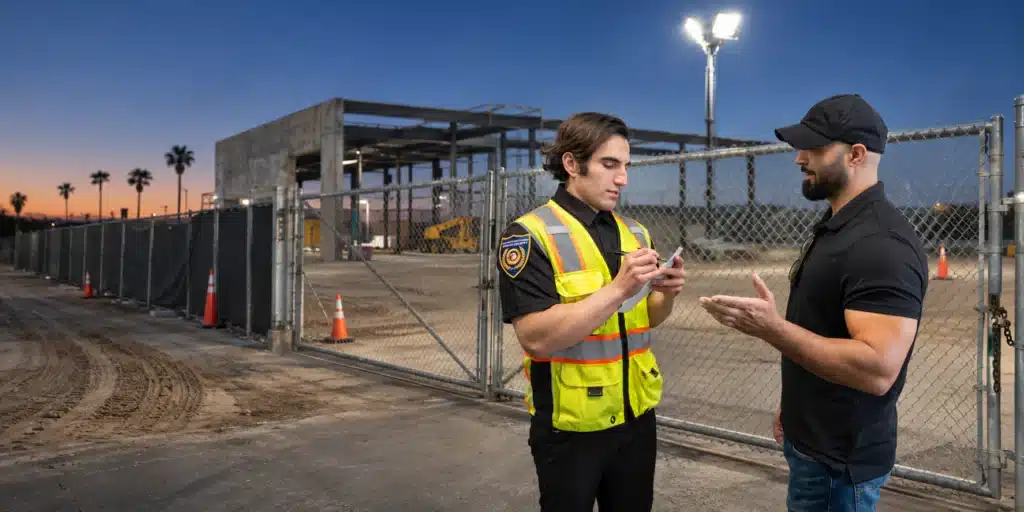
The construction site security checklist
Each section below is a short checklist you can copy into your own site plan. Assign every item to a named person, and check it on the schedule shown.
1. Plan and paperwork
- Write a site security plan before work starts, and update it at each phase change.
- Name one site security lead and one after-hours contact, with phone numbers.
- Keep a key and access list. Update it the day anyone leaves the job.
- List every machine with its make, model, serial number and PIN. Register equipment with NER so police can match it if it is found.
- Post emergency numbers at the gate: police non-emergency line, fire department, security company and site lead.
2. Perimeter and gates
- Keep the fence intact on every side, and fix gaps the same day.
- Lock every gate at the end of the shift, with a lock that cannot be cut in seconds.
- Post no-trespassing and security signs on the fence where they can be seen from the street.
- Walk the perimeter at the end of every shift, not just on Fridays.
3. Lighting
- Light the gate, the equipment and storage area, and any parking area.
- Use motion lights where power allows. Sudden light startles intruders and draws attention.
- Check that every light works before the site closes for the weekend.
4. Equipment and fuel
- Park heavy equipment together, inside the fence and away from it, so nothing can be driven straight out.
- Remove keys every night and keep them locked away from the machines.
- Use immobilizers or ignition locks where the equipment allows them.
- Lock fuel tanks and fuel storage.
- Move small, easy-to-load machines, such as compact track loaders and generators, into a locked container or off site at night.
5. Tools, copper and materials
- Keep tools in locked containers, and lock the containers every night.
- Schedule copper wire, appliance and fixture deliveries close to install time, so they do not sit on site for days.
- Keep a simple inventory of high-value materials and check it weekly.
- Install copper and fixtures in phases where you can, and secure finished rooms.
6. Access control during work hours
- Use one controlled entry for vehicles and deliveries.
- Sign in every visitor and subcontractor, with a daily list or badges.
- Check deliveries against paperwork at the gate.
- Watch for anyone photographing the site, the equipment or the storage area. It can be a sign that someone is planning a theft.
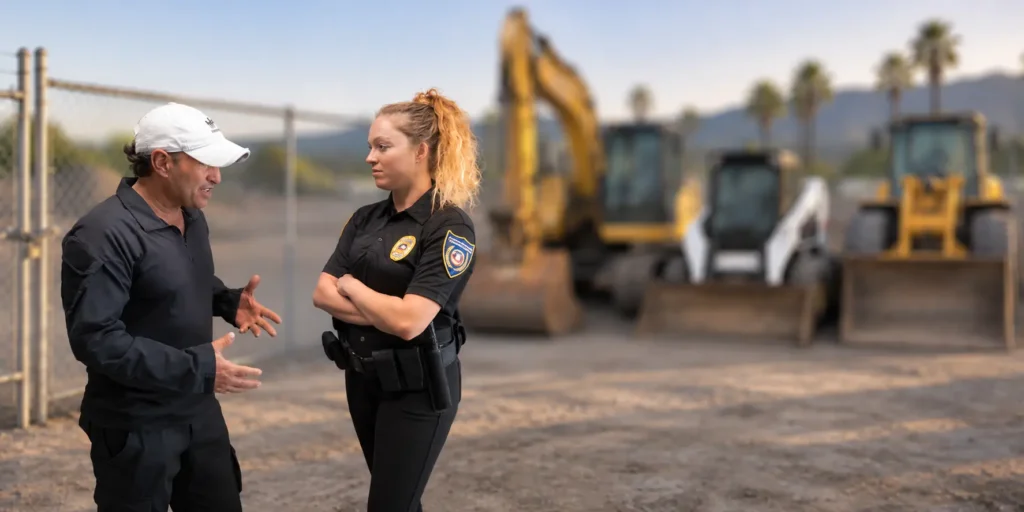
7. After hours, weekends and holidays
This is when most theft happens, so it deserves its own plan. You have two main options, and many sites use both.
- An on-site guard stays for the whole night or weekend, controls the gate and responds right away. It fits large or high-value sites, the finishes phase and sites with repeated theft.
- Mobile patrol sends an officer to check the site several times a night at random times. It fits smaller sites, early phases and contractors with several sites. Patrol officers can also lock gates during their stops and respond when a site alarm goes off.
Plan holiday shutdowns early. Sites often sit empty from late December to early January, which is the longest unattended stretch of the year. Our post on why construction site security is critical after working hours covers the risks in more detail.
8. Fire safety and fire watch
- Under the California Fire Code, hot work such as welding, cutting and grinding needs a fire watch during the work and for at least 30 minutes after it ends (CFC 3504.2.1).
- The fire code official, or your site safety plan, can require a fire watch on any construction or demolition site (CFC 3303.5).
- New buildings taller than 40 feet, or multistory buildings with more than 50,000 square feet per story, need a fire watch during nonworking hours (CFC 3303.5.1).
For the full rules, see when fire watch is required in California.
9. Incidents and reporting
- Report every theft to police the same day, with serial numbers, and report stolen equipment to NER.
- Keep a written incident log with photos, even for small losses.
- Review the log every month. Patterns show where the plan needs to change, such as one gate, one day of the week or one type of material.
Cameras, guards and patrols
Cameras are useful. They record what happened, they help with insurance claims and police reports, and visible cameras deter some thieves. Most ranking checklists are written by camera companies, though, so they rarely mention the other half of the picture.
A camera cannot stop a theft that is happening. A guard on site, or a patrol officer who arrives during a theft, can. The strongest plans use people and cameras together: cameras watch, and people respond.
Guard on site or mobile patrol?
| | On-site guard | Mobile patrol |
| How it works | An officer stays at the site for the whole shift |
| Best for | Large or high-value sites, finishes phase, repeated theft |
| Gate control | Yes, all shift |
| West Coast Security & Patrol rate | $24 to $35 an hour, unarmed |
Most construction sites do not need armed guards. Our guide to armed vs unarmed security guards explains when armed coverage makes sense.
If you arrive to a theft in the morning
Most contractors find a theft at 6 a.m., with a crew waiting at the gate. A short routine keeps the day from getting worse.
- Keep the crew out of the area until you have photos. Do not move anything you do not have to.
- Call the police non-emergency line and ask for a report number. Give serial numbers and PINs for any stolen machine.
- Report stolen equipment to NER the same day, so it can be matched if it turns up.
- Save any camera footage before it records over.
- Check the fence, gates and locks for the entry point, and fix it before the crew leaves that day.
- Call your insurer and your security company. Tell your security company what was taken and how, so coverage can change that night.
Then add the incident to your log, and give the site extra attention for the next few nights. Whoever came once now knows the layout.
How often to use this checklist
- At project start and at every phase change.
- Before every weekend and holiday shutdown.
- After any theft, break-in or near miss.
- Perimeter, lighting and equipment checks at the end of every shift.
Frequently asked questions
What should a construction site security plan include?
A named security lead and after-hours contact, a key and access list, an equipment list with serial numbers, rules for fencing, lighting and storage, after-hours coverage, fire watch needs and a way to report incidents. Update it at every phase change.
What is stolen most often from construction sites?
Hand tools, copper wire, fuel and small equipment such as generators and compact loaders are common targets, because they are easy to carry and resell. Appliances and fixtures become targets once the finishes phase starts.
Do I need a security guard on my construction site overnight?
Not always. Smaller sites in early phases often do well with random mobile patrol checks. Large sites, sites with high-value materials and sites with repeated theft usually need a guard on site overnight.
How much does construction site security cost?
At West Coast Security & Patrol, unarmed guards cost $24 to $35 an hour and mobile patrol costs $30 to $60 per visit. The total depends on the hours, the number of visits and the size of the site.
Does California require a fire watch on construction sites?
Sometimes. The fire code official or the site safety plan can require one, hot work always needs one during the work and for at least 30 minutes after, and some large new buildings need one during nonworking hours.
Get Construction Site Security in Southern California
West Coast Security & Patrol protects construction sites across Los Angeles, Orange, Riverside and San Bernardino counties, with on-site guards, mobile patrols and fire watch. Tell us about your site and your schedule, and we will put together a free security quote. We answer the phone 24 hours a day at 1 (800) 484-7062, or you can request a quote. See our construction site security services for more.


